

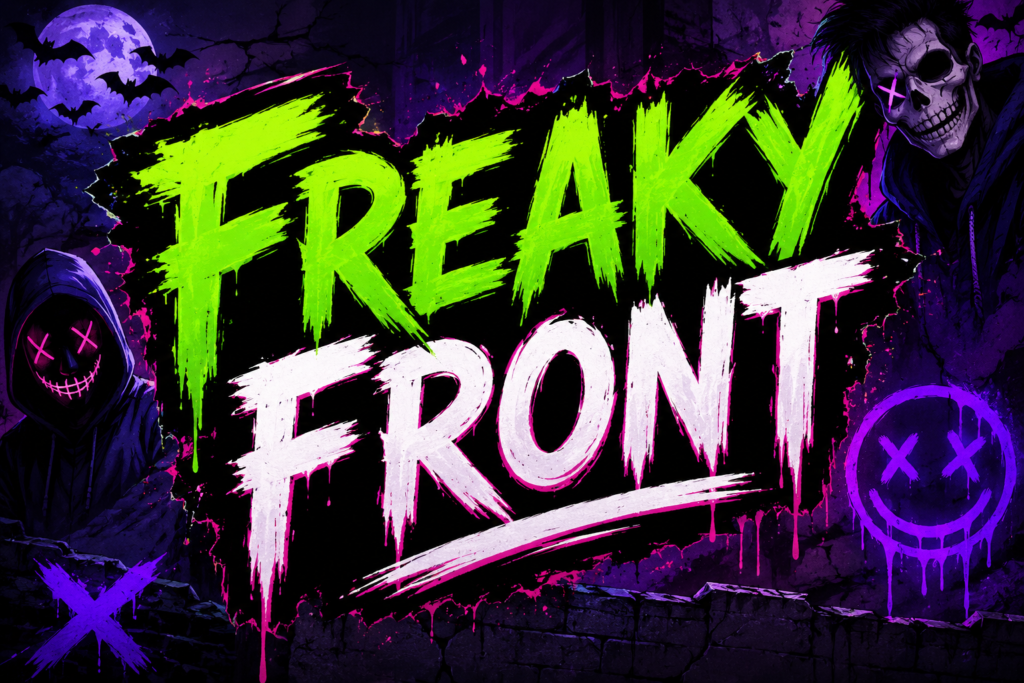
The internet has a unique way of turning ordinary words into interesting trends. Every day, new phrases, expressions, and combinations of words appear across social media, entertainment platforms, gaming communities, and online discussions. Some become popular because they describe a new trend, while others attract attention simply because they sound unusual or memorable. One phrase that can create curiosity is “Freaky Front.”
At first glance, the phrase may seem confusing because it does not have one universally accepted definition. Its meaning can depend heavily on where it appears, how it is being used, and what the surrounding conversation is about. Understanding this context is important before assuming that the phrase has a single specific meaning.
What Does “Freaky” Mean?
The first step toward understanding the phrase is looking at the word “freaky.” In everyday English, “freaky” generally describes something strange, unusual, unexpected, or slightly unsettling. Depending on the situation, it can also be used in a playful way to describe something unconventional or different from the ordinary.
For example, someone might describe an unusual fashion style as freaky because it looks different from traditional clothing. Similarly, an unexpected character in a game might be called freaky because of its strange appearance or behavior.
The word can therefore have different levels of meaning. Sometimes it is negative, while in other situations it can simply suggest creativity, uniqueness, or something outside the mainstream.
Understanding the Word “Front”
The word “front” is much broader. It can refer to the forward part of something a visible side a leading position or even the public-facing aspect of an activity.
In digital communities, words such as “front” can also be used creatively. A phrase may describe a visual style a character an online identity a particular design or a concept created for entertainment.
When “freaky” and “front” are combined, the result can sound intriguing even when there is no formal dictionary definition for the complete phrase.
What Is Freaky Front?
Freaky Front can be understood as a descriptive or creative phrase rather than a traditional English expression. Its interpretation may change according to the platform or community where it is used.
For some audiences, it may suggest something unusual or attention-grabbing at the front or visible part of a design. In another context, it could simply be a catchy phrase used for online content, entertainment, digital artwork a character or a creative project.
This flexibility is one reason unusual phrases can gain attention online. People do not always need a phrase to have a fixed dictionary definition before they start using it.
Why Are Unusual Phrases Becoming Popular?
Internet culture moves quickly. Social media platforms allow people to create, remix, and share language at an incredible speed. A phrase that appears in one post can quickly be repeated by hundreds or thousands of users.
Short and unusual phrases are particularly effective because they are easy to remember. They can also create curiosity. When people see a phrase they do not understand,they may search for it ask others about it, or use it themselves.
This creates a cycle:
New phrase → curiosity → searches → discussions → more visibility.
That process can turn an obscure expression into a recognizable online term.
The Role of Digital Creativity
One important reason phrases like Freaky Front attract attention is the growth of digital creativity. People now have access to tools for creating images text font emojis videos games and other forms of digital content.
Websites offering symbols, emojis, text converters, and creative generators make it easier for users to experiment with different styles. For example, platforms such as Freaky Front can be associated with the broader world of online text and creative expression, where users experiment with unusual characters, symbols, and digital formats.
This type of experimentation contributes to the constant evolution of internet language.
Freaky Front and Online Communities
Online communities often develop their own vocabulary. Gaming groups, social media communities, fan groups, and creative forums may use words differently from traditional dictionaries.
A phrase can therefore become meaningful within a particular community even if people outside that community have never heard it before.
This is especially common among younger internet users. Memes, abbreviations, slang, and creative phrases can spread rapidly through platforms such as TikTok, Instagram, Discord, Reddit, and gaming communities.
The meaning may also change over time. A phrase that starts with one interpretation can eventually develop several meanings depending on how people use it.
Is Freaky Front Connected to Gaming?
Not necessarily, but digital entertainment can play a role in spreading unusual phrases. Gaming is one of the largest areas of online culture, and players constantly encounter new characters, names, challenges, trends, and expressions.
Mobile gaming has made this even more widespread. The Google Play platform, for example, provides access to a huge range of Android games and apps, giving users another environment where creative names and unusual terminology can become familiar.
However, it is important not to assume that every appearance of “Freaky Front” refers to a specific game or application. The surrounding context should always be considered.
Why Context Matters
One of the biggest mistakes people make when researching an unfamiliar internet phrase is assuming that the first meaning they find is automatically correct.
Online language does not always work that way. A phrase can be:
- A nickname
- A username
- A creative title
- A meme
- A search trend
- A gaming reference
- A design concept
- A social media expression
- A phrase created for entertainment
Because of these possibilities, the meaning of Freaky Front should be interpreted according to its specific context.
How to Research a Trending Phrase
If you encounter an unfamiliar phrase online, there are several simple ways to understand it.
First, search for the exact phrase rather than individual words. Searching the complete phrase can reveal how other people are using it.
Second, check the platform where you discovered it. A phrase appearing on a gaming website may have a very different meaning from one appearing on a fashion or social media page.
Third, look at recent posts and discussions. Internet terminology changes quickly, so older explanations may not always reflect current usage.
Finally, avoid relying on one source. Comparing several examples can help you identify whether a phrase has a common meaning or is being used differently by different groups.
Why “Freaky Front” Is Interesting
The appeal of Freaky Front comes partly from its ambiguity. It sounds distinctive enough to make people wonder what it means. That curiosity can encourage searches and conversations.
In the modern internet environment, curiosity itself can contribute to visibility. People often click on unfamiliar terms simply because they want an explanation.
This is also valuable for content creators and marketers. Unique phrases can make headlines, usernames, campaigns, and creative projects more memorable when they are used appropriately.
Freaky Front is an interesting example of how modern online language can create curiosity without necessarily having one fixed definition. The phrase can be interpreted differently depending on the platform, audience, and context in which it appears.
Rather than immediately assigning one meaning to an unfamiliar phrase, it is better to examine how people are actually using it. Looking at surrounding content, recent discussions, and the platform where the phrase appears can provide a much clearer understanding.
Ultimately, the internet is constantly creating new expressions. Some become major trends, while others remain small community references. Whether Freaky Front becomes a widely recognized phrase or simply remains an interesting piece of online vocabulary, its appeal demonstrates one thing clearly: the way people communicate online is always changing.